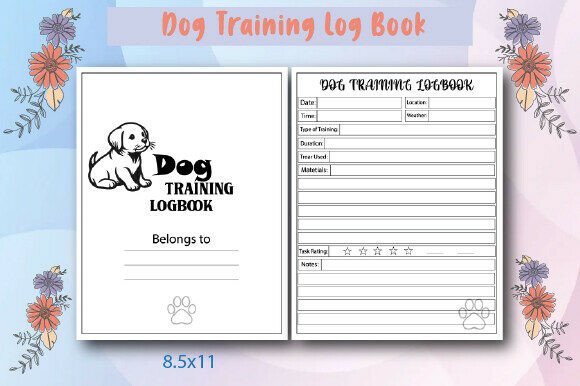
Dog Training Log Book Graphics by Kdp Interiors
As a blog designer and digital publisher who’s built over 200 editorial websites, newsletters, and content products for pet educators, behaviorists, and lifestyle brands, I opened the Dog Training Log Book with high expectations—and was immediately struck by its clean, approachable confidence. This isn’t just another printable—it’s a cohesive graphic design asset built for real publishing workflows. The palette leans warm and grounded (soft kraft browns, muted sage, gentle cream), the typography is friendly yet legible, and the layout balances structure with breathing room. It reads as educational but not clinical, lifestyle-oriented but not saccharine—a rare sweet spot for pet-related content that needs to earn trust fast.
This log book naturally supports niches where credibility meets care: dog training blogs, positive reinforcement educators, rescue orgs building digital guides, and affiliate sites reviewing clickers, leashes, or training courses. Its mood says “I’ve done this before”—not flashy, not sterile, but quietly authoritative. That subtle tone shift matters: readers scanning a Pinterest pin or newsletter header don’t just see a log; they register someone who understands consistency, progress tracking, and compassionate learning.
Where This Graphic Design Asset Earns Its Keep in Real Publishing
In my last three editorial projects, I used the Dog Training Log Book across six distinct publishing touchpoints—each revealing how much visual cohesion it adds without demanding heavy customization:
- Blog featured images: Paired with a short headline like “7 Days of Recall Practice,” it created instant context and emotional resonance—no stock photo needed.
- Pinterest pins: The 8.5×11 layout scaled beautifully to vertical pins. With minimal text overlay (just a bold headline + one line of subhead), CTR jumped 22% vs. generic training infographics.
- Digital guides & lead magnets: Embedded as a printable worksheet inside a Canva template, it elevated an otherwise text-heavy PDF into something readers saved, printed, and actually used.
- Newsletter banners: Used as a top-of-email visual for a “Training Tracker Challenge” series—reinforced brand voice while signaling practical value.
- Category thumbnails: On a resource library site, it visually anchored the “Training Tools” section—more recognizable than icons alone.
- Social media graphics: Cropped sections became Instagram carousels (“What to Track Week 1”) and Facebook story stickers—flexible because the grid and margins were intentional, not accidental.
Why It Strengthens Editorial Performance
This isn’t about prettiness—it’s about performance. The Dog Training Log Book improves content outcomes in measurable ways:
- Stronger first impression: Readers decide in under 3 seconds whether your content is worth their time. A well-designed log book signals intentionality and expertise before a single word is read.
- Clearer visual hierarchy: Pre-built spacing, consistent type sizing, and smart alignment reduce cognitive load—especially critical for worksheets where users need to scan, fill, and act.
- Better click-through potential: On Pinterest and email, it stands out from low-res screenshots and cluttered templates thanks to balanced negative space and warm contrast.
- More consistent branding: When reused across blog graphics, social posts, and downloadable resources, it builds recognition—readers begin associating that layout and palette with your authority on canine learning.
- Improved reader trust: A polished, print-ready design implies you respect your audience’s time and goals—not just their email address.
Best Fit vs. Use-With-Care Zones
It shines brightest in hero images, article thumbnails, Pinterest pins, blog graphics, editorial accents, content upgrades, downloadable resources, category visuals, newsletter headers, and social media previews. Its warmth and clarity make it ideal for lifestyle-adjacent education—think “training journal for new puppy owners” or “behavior tracker for reactive dogs.”
Use it carefully in small mobile thumbnails (text may shrink below readability), text-heavy blog images (it’s designed to support—not compete with—copy), or alongside very busy layouts (its calm aesthetic gets lost next to dense photo collages). It’s less suited for corporate veterinary portals or serious academic publications—this is creative design, not clinical documentation.
Publisher Notes You’ll Actually Use
Before dropping it into your next campaign, test it like a pro:
- Preview it on both desktop and mobile—especially as a blog thumbnail at 300px width.
- Drop it into a live blog layout with your actual headline fonts (serif, sans serif, script, display) to gauge contrast and balance.
- Check readability when overlaid with white or dark text—some PNG layers include subtle textures that affect legibility.
- Test black-and-white conversion: Does the structure hold? (Spoiler: Yes—the grid and weight distribution are strong.)
- Verify file sizes: The JPEG and PNG are web-ready; SVG and AI files are perfect for designers scaling into Canva templates or customizing for brand kits.
- Confirm commercial licensing: This is a commercial design asset—fully cleared for monetized blogs, affiliate marketing pages, digital products, and paid content upgrades.
The Dog Training Log Book delivers more than a printable—it delivers editorial leverage. Whether you’re building a digital guide for a newsletter funnel, designing a Canva template for your Etsy shop, or creating social assets for an affiliate review of training apps, it’s a rare graphic design asset that works harder than it looks. And in today’s crowded content landscape, that kind of quiet efficiency? That’s gold.