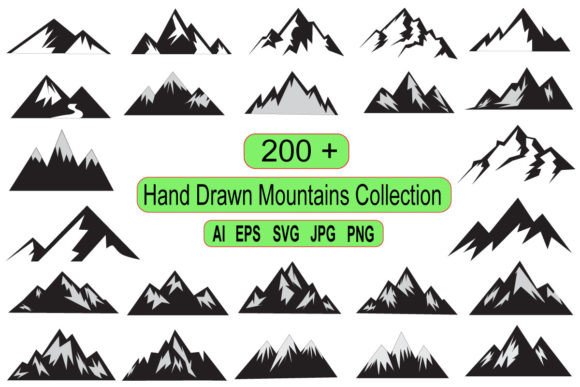
Hand Drawn Mountains Graphic Collection
A Designer’s First Look: What This Collection *Feels* Like Before the Needle Moves
Unzipping Hand Drawn Mountains Graphic Collection felt like opening a sketchbook left on a cabin porch—loose, warm, quietly confident. These aren’t crisp vector peaks or symmetrical silhouettes. They’re 200 distinct mountain profiles, each with uneven contours, subtle line weight shifts, and that gentle, human hesitation you only get from pen-on-paper. As an embroidery designer who’s stitched everything from tiny baby onesies to boutique aprons, my first thought wasn’t “Will it digitize?”—it was “Which of these will hold up *as thread*, not just as art?”
Why It Works So Well for Real Embroidery Projects
I tested three designs from the collection on a custom embroidered tote bag for a local hiking gear shop—and the response was immediate. Customers paused, pointed, asked, “Did you draw those yourself?” That handmade authenticity translates directly into perceived value. The lines are bold enough for satin stitch definition but soft enough to avoid harsh edges on curved surfaces like caps or pillow covers. On a sweatshirt, the mid-weight outlines held clean without over-stuffing the fabric; on a tea towel, the same design read clearly even at 3.5 inches wide—no blurring, no lost detail.
This collection shines in projects where mood matters as much as motif: nursery decor (think minimalist mountain skyline on a linen crib sheet), personalized gifts (a single peak stitched beside a child’s name on a backpack), or small shop merchandise (a set of three staggered ranges on matching aprons). Because the drawings vary in height, density, and rhythm, they adapt naturally—no two placements feel repetitive. That’s gold for Etsy sellers building cohesive product lines.
Where to Use It Thoughtfully—Not Just Everywhere
Not every mountain suits every surface. I learned this the hard way stitching one of the more intricate, layered ranges onto a lightweight cotton baby onesie: the fine interior lines blurred under dense fill stitch. For delicate fabrics—thin knits, stretchy jersey, or textured linens—stick to the simpler, bolder profiles in the collection. Avoid the most tightly clustered peaks on dark fabrics unless you’re using high-contrast thread; some subtle line variations vanish without careful color pairing.
Curved surfaces demand attention too. That beautiful, winding ridge with five distinct summits? Gorgeous on a flat tote—but on a structured cap front, the outer peaks stretched and distorted slightly. For caps or hats, choose designs with open negative space and fewer abrupt directional shifts. And while the collection includes no lettering, don’t assume you can easily add names inside valleys—the tightest corners in some drawings leave little room for clean running stitch transitions.
What This Means for Your Finished Product
When Hand Drawn Mountains Graphic Collection lands right, it elevates your entire offering. A simple embroidered patch feels intentional, not generic. A holiday gift—say, a mountain-stitched kitchen towel—feels personal, grounded, and quietly sophisticated. Buyers notice the difference between mass-produced clip art and something that breathes like hand-drawn work. That perception builds trust, especially for craft businesses and handmade shops where storytelling and authenticity drive sales.
It also supports brand consistency without locking you in. You can use one mountain as a subtle tagline accent on packaging, another as a full-back embroidery on apparel, and a third—simplified—on a printable mockup for your Etsy listing. As digital embroidery files go, this is unusually flexible visual language.
Practical Notes Every Embroidery Designer Should Check
- Always test on scrap fabric first—especially with textured or dark materials. What reads beautifully in PNG may need adjusted stitch density in the actual embroidery file.
- Review thread color contrast carefully. Some mountains rely on subtle line variation—not just shape—to convey depth. Low-contrast thread on light fabric can flatten that intention.
- Confirm hoop size compatibility. While the AI and SVG files let you scale freely, the final embroidery file’s dimensions must match your machine’s maximum hoop area—especially for wider panoramas.
- Inspect small details before stitching. Zoom in on the smallest peaks and valley dips. If they’re under 1.5mm in your digitized version, they may collapse into fill stitch or disappear entirely.
- Test black-and-white mockups. If the design loses its character without color, it may not translate well across varied product backgrounds.
- Use appropriate stabilizer. Medium-weight cutaway works best for apparel; tear-away suffices for stable woven fabrics like tea towels or tote canvas.
- Verify licensing for commercial use. Since this is a Graphics product in the Illustrations category, confirm whether resale of finished embroidered items—or redistribution of digital files—is permitted under the included license.
Final Thought: Not Just Another Mountain Design
Hand Drawn Mountains Graphic Collection isn’t about adding scenery—it’s about adding voice. In a market flooded with perfect, predictable peaks, these 200 drawings offer irregularity with intention, simplicity with soul. They work because they were made to be *felt*, not just seen. Whether you’re prepping a custom embroidered patch for a trail-running club, designing a batch of baby embroidery kits, or building digital embroidery file bundles for fellow Etsy sellers, this collection delivers usable, expressive, stitch-ready assets—no over-editing required. Just choose the peak that fits your project’s rhythm, test it thoughtfully, and let the hand-drawn honesty do the rest.