House Plants Care Planner Graphics for Kdp Interiors
As a blog designer who’s built over 200 editorial websites and launched dozens of digital guides for lifestyle brands, I opened House Plants Care Planner expecting another decorative printable — but what landed in my inbox was a surprisingly cohesive, production-ready graphic design asset built for real-world publishing. Not just “cute” — functional, scalable, and editorially intelligent.
The first impression? Calm, grounded, and quietly confident. It leans into soft botanical minimalism — think muted sage greens, warm clay tones, subtle line art, and generous whitespace — without veering into overly feminine or twee territory. That balance makes it ideal for content that bridges wellness, interior design, sustainable living, and mindful homekeeping. Readers instantly register trust: this isn’t clip art slapped onto a calendar. It’s editorial design with intention — the kind that says, “I’ve thought about your light-filled corner shelf *and* your watering schedule.”
Where House Plants Care Planner Earns Its Place in Real Publishing Workflows
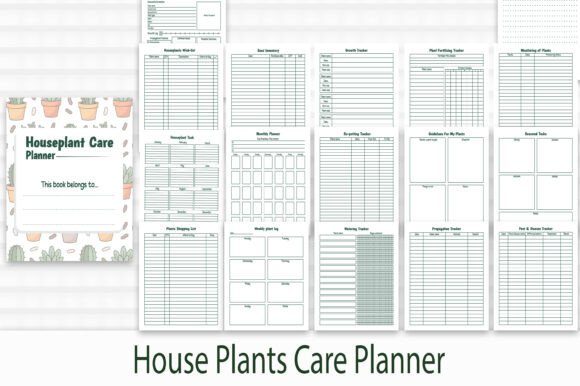
This isn’t a one-off Pinterest pin. It’s a modular system — 18 high-resolution pages, 17 clean PNGs, vector AI + SVG files, print-optimized CMYK PDFs, and JPEGs at 300 DPI. That means it scales across touchpoints without compromise:
- Blog featured images — Pair a full-page planner layout with bold serif headlines; the contrast between organic illustration and strong typography creates instant visual hierarchy.
- Pinterest pins — The vertical compositions and clear focal points (e.g., a watering checklist beside a monstera sketch) stop scrollers mid-feed.
- Digital guides & lead magnets — Use individual pages as chapter dividers or embed editable sections into Canva templates for subscriber-only resources.
- Newsletter headers & category thumbnails — Crop the minimalist plant icons or seasonal care calendars to reinforce topic recognition at a glance.
- Website banners & editorial accents — Layer subtle SVG line art behind headline text on an interior design blog homepage — it adds texture without competing.
- Affiliate marketing visuals — Overlay transparent PNGs onto product roundups (“Our Top 5 Self-Watering Pots”) to soften commercial messaging with warmth and authenticity.
Why This Asset Strengthens Content Performance — Not Just Aesthetics
In my work with newsletter creators and online educators, visual consistency directly impacts open rates, time-on-page, and conversion. House Plants Care Planner delivers measurable advantages:
- Stronger first impression — Clean layouts signal authority, especially in niches where readers distrust overly polished stock imagery.
- Better click-through potential — On Pinterest and email previews, its balanced color palette and clear focal points outperform generic “plant background” JPEGs.
- More consistent branding — With vector files and coordinated color palettes, you can extend the look into custom social media graphics or branded worksheets — no mismatched fonts or clashing tones.
- Improved reader trust — Hand-drawn accuracy (note the realistic leaf veins and pot textures) tells readers this wasn’t AI-generated in bulk — it was crafted.
- Stronger visual identity — Reusing recurring motifs (e.g., the same terracotta planter icon across a digital guide, blog sidebar, and Instagram Story) builds subconscious recognition.
Best Fit: Where This Graphic Design Asset Shines
It thrives in spaces where warmth, clarity, and gentle guidance matter most:
- Hero images for “Beginner Plant Care” blog posts
- Pinterest pins optimized for search terms like “indoor plant watering schedule”
- Downloadable printables bundled with affiliate reviews
- Category thumbnails for “Home & Wellness” or “Sustainable Living” hubs
- Newsletter headers that feel personal, not promotional
- Social media previews for digital product launches (e.g., “My Plant Journal Bundle”)
Use With Intention: Contexts That Need Extra Review
This is not a universal drop-in solution. Exercise care when:
- Scaling down to tiny mobile thumbnails — some delicate line art loses legibility under 200px width.
- Layering over busy photo backgrounds — its soft tones recede unless given solid contrast.
- Supporting serious professional niches (e.g., corporate wellness reports or medical gardening therapy guides) — its warmth may undercut required gravitas.
- Integrating into ultra-minimalist brand systems — if your site uses only black, white, and one accent hue, test how its earthy palette aligns before full rollout.
Publisher Notes You’ll Actually Use
Before launching House Plants Care Planner into your next campaign, run these checks — I do them every time:
- Preview it inside your live blog theme — does the spacing around headlines still breathe? Does it load fast on mobile?
- Test thumbnail visibility: shrink it to 150x150px — is the core message still readable?
- Overlay headline text using your brand’s primary font stack (serif, sans, script, display) — check contrast ratios for accessibility.
- Convert to grayscale — does the composition hold up? If key elements vanish, adjust brightness or add subtle outlines.
- Place beside common body fonts — does the illustration complement or compete with paragraph rhythm?
- Verify file size: compress JPEGs for web use (aim for under 250KB), preserve SVGs for crisp scaling, and keep AI files for future edits.
- Confirm commercial license coverage — especially for monetized newsletters, affiliate landing pages, or Canva templates sold via your own shop.
For bloggers building authority, small business owners curating digital products, and creative entrepreneurs launching content upgrades, House Plants Care Planner isn’t just another digital download. It’s a quietly powerful creative design tool — one that elevates content marketing through thoughtful restraint, supports affiliate marketing with authentic charm, and strengthens small business branding without shouting. In the crowded creative marketplace, assets like this don’t just decorate — they deepen connection, clarify intent, and turn casual readers into returning subscribers.